
The Chief Health Officer: The Hidden Role Inside Millions of Families
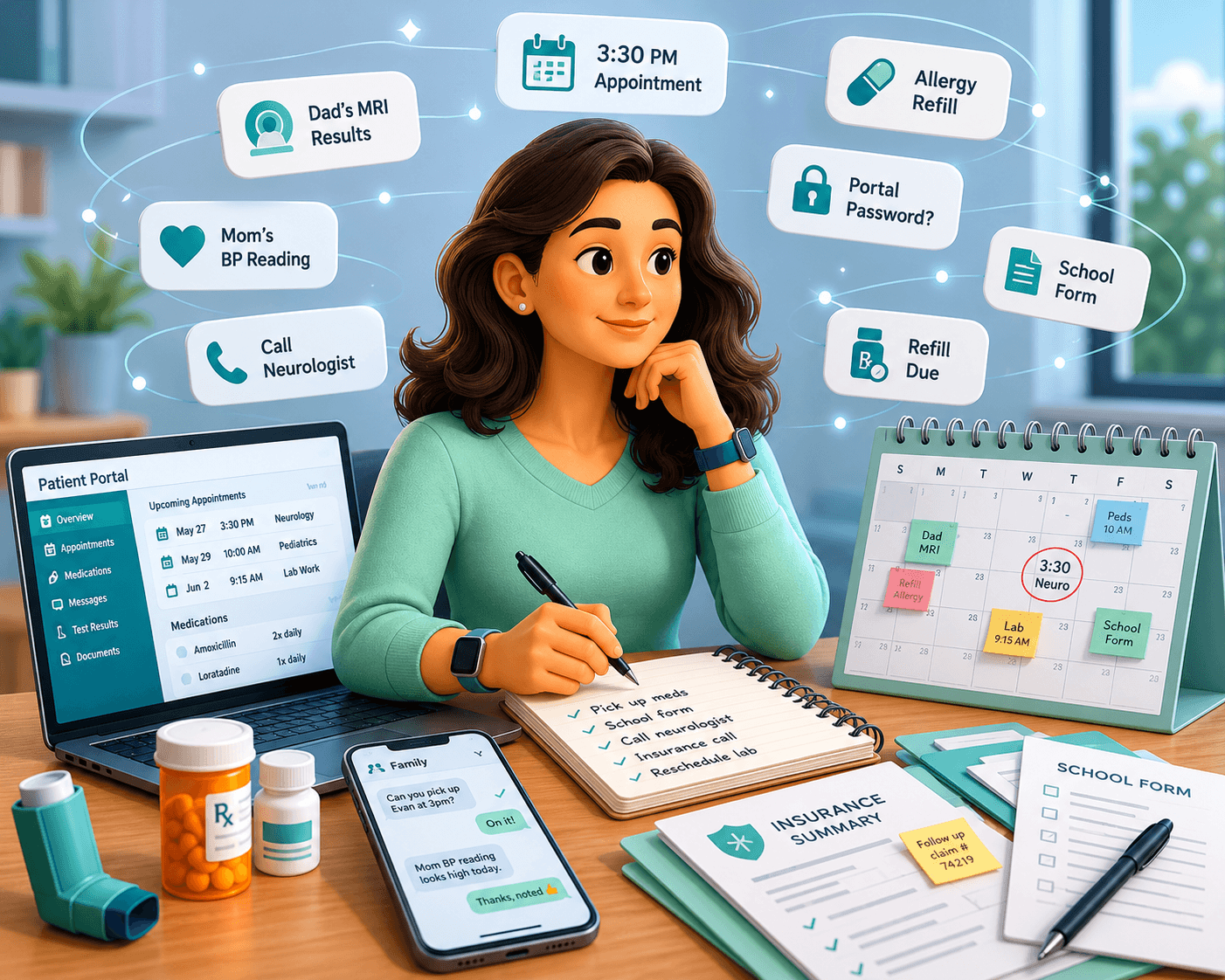
Inside many households, one person quietly coordinates the family's healthcare across memory, messages, portals, paperwork, and appointments.
Raj Subramonian
Founder & CEO · May 26, 2026
Inside millions of households, one person quietly runs the family's healthcare system.
She remembers medications. She tracks appointments. She knows which portal has the MRI result. She explains the discharge instructions to everyone else. She notices when something feels "off". She carries the story when nobody else can.
Most families do not call this person anything.
But modern healthcare increasingly depends on her.
She is the Chief Health Officer.
The Chief Health Officer is the person inside the household who coordinates healthcare across children, spouses, parents, medications, appointments, records, insurance, and decisions.
Modern healthcare quietly created a new household role.
The Cognitive Burden Nobody Sees
Healthcare coordination rarely looks dramatic from the outside. It looks like a phone on the kitchen counter, a half-open laptop, a medication bottle near the coffee cup, a school form waiting for a signature, a portal password no one can remember, and a sticky note that says "call neurologist".
But inside one person's head, those fragments become an operating system. Appointment times. Medication names. Family history. Insurance rules. Symptoms. Provider names. Lab values. The question a spouse forgot to ask. The discharge instruction that might matter later.
The work is not only administrative. It is cognitive and emotional. Someone has to notice, remember, translate, prioritize, follow up, and decide what needs attention now versus what can wait.
The family healthcare system runs on invisible coordination work.
A Day in the Life of the Chief Health Officer
At 6:30 AM, she is packing lunches.
At 8:10, she is messaging the pediatrician about the refill.
At lunch, she is calling insurance about a denied MRI.
At 4:45, she is trying to remember whether her father's cardiologist changed the dosage last month.
At 11:30 PM, she is searching old portal messages because nobody can find the discharge instructions.
And tomorrow starts again.
Why This Role Falls Mostly Onto Women
The role can belong to anyone. Fathers do it. Adult children do it. Spouses do it. But across many households, women still disproportionately carry the coordination burden.
That matters because women's lives changed faster than household systems did. In 1975, fewer than half of mothers with children under 18 were in the labor force. By 2021, that share had risen from 47.4% to 71.7%, according to the U.S. Bureau of Labor Statistics.
And mothers are not only earning supplemental income. A 2025 Center for American Progress analysis found that 45% of U.S. mothers were breadwinners in 2023, meaning they were sole, primary, or co-breadwinners for their families.
So the old picture of one parent quietly absorbing the household health load does not match modern life. Many women are managing healthcare coordination while also carrying major economic responsibility.
71.7%
Mothers in the labor force
The share of mothers with children under 18 in the labor force in 2021, up from 47.4% in 1975. (BLS)
45%
Breadwinning mothers
Share of U.S. mothers who were sole, primary, or co-breadwinners in 2023. (Center for American Progress)
$600B
Unpaid family care
Estimated annual economic value of unpaid family caregiving in the U.S. in 2021. (AARP)
Healthcare became a second job for millions of women.
The Family Is Getting More Complex Too
The burden is growing not only because parents are busy. It is growing because families are often responsible for care in multiple directions at once.
Pew Research Center has found that about 23% of U.S. adults are part of the sandwich generation, with a parent age 65 or older and either a child under 18 or an adult child they have helped financially.
AARP and the National Alliance for Caregiving describe the typical family caregiver as a 49-year-old woman, and many caregivers are also employed. That means healthcare coordination often lives in the margins: before work, after bedtime, between meetings, during school pickup, or while waiting on hold.
This is where the title "Chief Health Officer" becomes useful. It names the work without exaggerating it. It helps us see that someone is managing a multi-person health operation with almost no designed infrastructure.
Healthcare Coordination Is Real Work
We built digital infrastructure for banking, transportation, communication, shopping, travel, and work collaboration. We can move money, book a flight, coordinate a team project, order groceries, and find a ride with tools that remember context and reduce friction.
But family healthcare coordination is still happening through memory, text messages, screenshots, PDFs, notebooks, medication photos, voicemail, and fragmented portals.
That mismatch is not a small inconvenience. It is a broader societal issue. Families are being asked to manage more healthcare complexity than ever, but the tools they are given are still mostly institutional tools: portals for providers, claims systems for insurers, forms for offices, and discharge papers for hospitals.
What families need is infrastructure for shared understanding: a way to keep the story together across people, places, decisions, and time.
One person should not have to remember everything.
Families Need Better Infrastructure for Healthcare
The goal is not to turn family life into a dashboard. It is not to optimize people into machines. And it is not to imply that caring for loved ones is a burden in itself.
The problem is that love is being asked to compensate for fragmentation.
A mother should not have to remember every medication change from memory. A spouse should not have to scroll through months of texts to reconstruct what happened. An adult child should not have to piece together a parent's care from portal screenshots and hurried phone calls. A family should not have to depend on the most organized person being healthy, available, and emotionally steady at all times.
Better infrastructure would make healthcare coordination more shared, durable, and humane. It would help families preserve context, divide responsibility, prepare for visits, understand changes, and make decisions with less fear that something important is being missed.
A Better Way to Hold the Story Together
Healthcare has become too complex for families to manage through memory alone.
Too much important information now lives across portals, paperwork, text messages, discharge instructions, voicemail, and mental notes carried by a single person trying to keep everyone aligned.
We built Mediphant to support the Chief Health Officer (CHO) in every family. An operating system that every CHO would love!
A shared home base to organize records, track changes, prepare for visits, share updates, and keep the healthcare story together across time.
Because the person carrying the coordination burden should not have to carry it alone.